Against Solidarity
A critique of Rowan Williams's "Solidarity: The Work of Recognition"

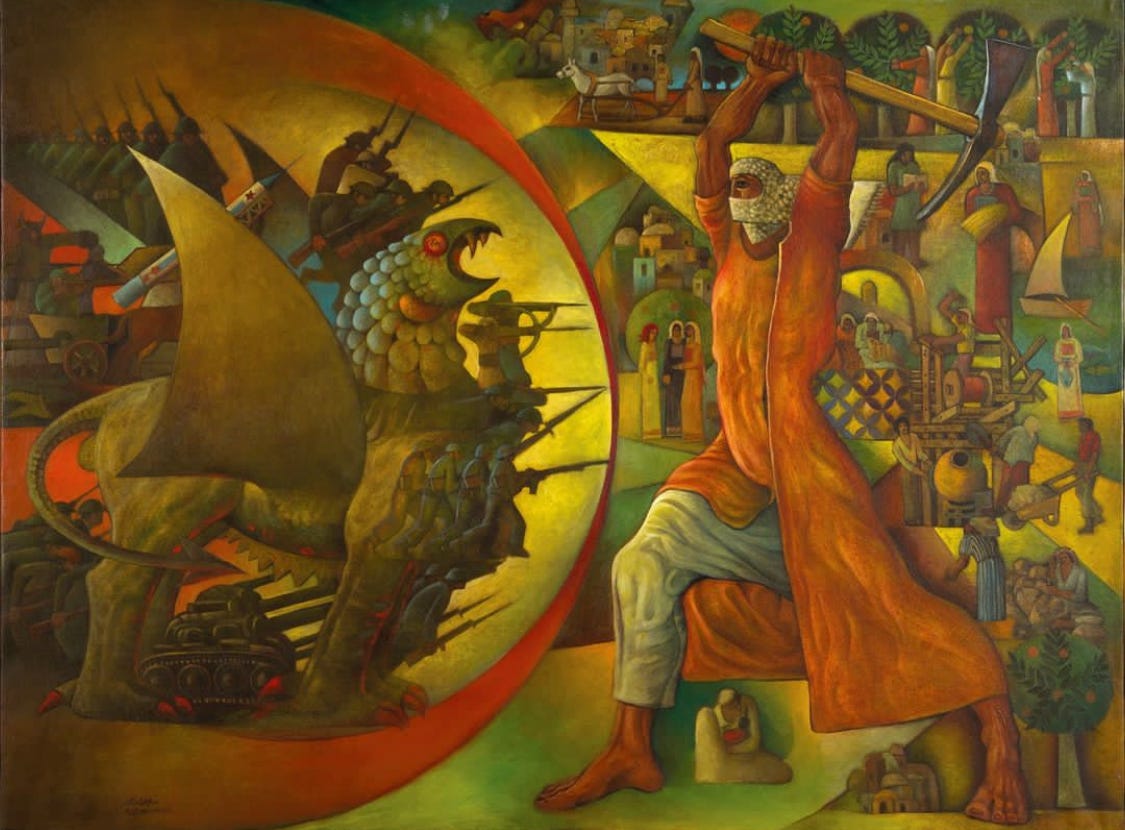
Sliman Mansour, Resisting Israeli Settlements, 1978
INTERVIEWER: Why won’t your organization engage in peace talks with the Israelis?
KANAFANI: You don’t mean exactly peace talks. You mean capitulation, surrendering.
INTERVIEWER: Why not just talk?
KANAFANI: Talk to whom?
INTERVIEWER: Talk to the Israelis
KANAFANI: That’s kind of a conversation between the sword and the neck.1
Above is a segment from a 1970 interview in Beirut between Australian journalist Richard Carleton and Popular Front for the Liberation of Palestine (PFLP) spokesman Ghassan Kanafani. Two years later Kanafani, along with his 17 year-old niece, would be killed by a car bomb planted by the intelligence arm of the Israeli state Mossad. Since Kanafani’s death, the Palestinian people have struggled against the settler state of Israel, whose genocidal war against the Palestinians has accelerated since the assault of October 7th, 2023. Palestine has become the global flashpoint for far-right movements, revitalizing the left within the imperial core of North America and Western Europe and forcing it to re-evaluate its relationship with the state in the midst of heightened repression. The Palestinian struggle has forced many movements on the left to recenter questions pertaining to solidarity along the lines of unconditional opposition to imperialism, settler-colonialism, and capitalism.
Within the field of Euro-American theology, the former Archbishop of Canterbury Rowan Williams recently published Solidarity: The Work of Recognition, a work of political theology that seeks to elaborate upon the duties and obligations that solidarity as a virtue places upon us. Seeking to overcome the widening rifts rending the crisis-ridden imperial world-order, Williams asks if there may be “a way of engaging, speaking together, that does not presuppose an ultimate incommensurability in human goods, and thus an unavoidable contest about control?”2
Williams’s Solidarity stands out in its efforts to avoid easy answers. Williams denounces the appeal to nostalgia of “simple belonging-together” that many Euro-American fascist political movements have electorally leveraged to gain state power.3 Refreshingly, Williams attempts to avoid grounding the universality of solidarity in “organic patterns of common life” or some “‘pre-existing harmony,” asserting through his reading of Heinrich Pesch that human beings are “irreducibly historical agents.”4 Williams is more attentive than many theologians to the centrality of labor that constitutes solidarity, as well as the ease with which one may fall back to “ethical shortcuts” to go around said labor.5 Crucially, Williams argues that the acknowledgement of and capacity to work from the historical asymmetry between privileged and non-privileged is essential for solidarity to unfold. “What is needed is an acknowledgement by the privileged of the reality of where they stand, and a readiness to work, with consciousness and clarity, from that point…this is indeed a different history from that of the non-privileged or subaltern or oppressed subject.”6 Williams here warns against the characterization of recognition as one happening between two formally equal parties, pushing towards a notion of solidarity that must work through the messiness of history if it is to be a solidarity worthy of the name.
At the same time, key moments in Williams’s Solidarity undermine his thesis regarding recognition and solidarity. These moments are not incidental to Williams’s framework, but constitutive of it. It isn’t that Williams’s solidaristic framework is inapplicable to the case of the settler state. Worse, in the case of Israel and Palestine, Williams refuses to follow the logic of his “solidarity without enemies” whenever its logic actually threatens to name enemies. Williams undermines the historical embodiment core to his interpretation of solidarity, either leveling the (to put it lightly) asymmetrical power relations or projecting the horror of settler colonialism into the realm of pre-political ontology. Williams’s “solidarity without enemies” reifies the genocidal logic of the settlerist foundations of global capitalism at the very moment it ought to confront it. The high price Williams pays for his unwillingness to name an enemy or name the stakes beyond blandly labeled “conflict” or “violence” is a form of solidarity that is not only deprived of any critical bite, but risks running cover for the genocidal violence that drives the global order of capitalist accumulation.
A Conflict with No Antagonists, the Violence with No Name
The manner in which Williams writes about the Palestinian genocide grounds the contradiction between where his logic leads and what his formal conclusions dictate. When talking about the genocide in Gaza, Williams references the Gazan genocide and the many ways in which solidarity emerges across political and geographic lines. People wear the Palestinian keffiyeh “to share the experience of the victims of bombardment in Gaza” while “Jewish activists in Europe and North America also take to the streets in the name of solidarity with a whole nation faced by hostile neighbors whose aim is its annihilation…”7
There are two things to note here about the form of Williams’s description. First, he uses the word “bombardment,” depoliticizing an unfolding genocide by displacing the “bombardment” out of its wider historico-political context. Williams’s formulation renders unclear precisely who is doing the bombardment, only that it’s occurring. At the same time, Williams does not afford the Palestinians the same courtesy he afforded the Israelis, characterizing the events of October 7th as an “initial murderous attack by Hamas militants.” Even as Williams on the one hand asserts the universality of solidarity, he assigns on the other hand responsibility asymmetrically, depending on whose violence is being described.
Second, Williams’s characterization of Israel as “a whole nation faced by hostile neighbors” renders it a passive recipient of rancour from the rest of the region. Why exactly is there so much anger towards Israel from its neighbors? Is this connected to the subjectless “bombardment” unfolding both within Palestine and in neighboring countries? Williams leaves this unclear. And by leaving this unclear risks legitimating the accusations of many Zionists that the opposition against Israel is fundamentally rooted in antisemitism that has no rationale, purpose, or reason. Williams may personally believe that Israel may have the lion’s share of the fault for the ongoing genocide, but by playing fast and loose with the assignment of responsibility, cedes ground to Zionists working to delegitimize every form of critique that threatens Israel’s hegemony within ideological discourse.
The form through which Williams brings together and renders commensurate these two acts of “solidarity”—the person donning the keffiyeh in solidarity with a people resisting genocide, the “Jewish activist” taking to the streets in solidarity with the settler state perpetuating said genocide—risks the erasure of genocide perpetuated by Israel alongside its allies. Williams’s hesitancy to even name the genocide is quite surprising considering even politically moderate organizations such as the United Nations Independent International Commission of Inquiry on the Occupied Palestinian Territory have concluded that the genocide is happening and that Israel is perpetuating it.8 Such unwillingness to acknowledge the genocide this late in its development casts a heavy shadow. Williams may write about the ubiquity of solidarity among all political corners, but, as will be demonstrated below, this rhetorical point is purchased at an extraordinarily steep cost of formally stripping the asymmetrical relation between colonized Palestinians and settler Israeli state he is seeking to at least maintain.
In another place, Williams acknowledges the asymmetries of power between the Palestinian and the Israeli. He critiques psychologist Simon Baron-Cohen’s claim that “any problem immersed in empathy becomes soluble” in the latter’s depiction of a meeting between an Israeli and Palestinian father who have both lost their sons and have come together to advocate for reconciliation. Williams warns that between the two bereaved fathers “there will be asymmetries of power and privilege, and indeed of risk; there will be the danger of expecting the less powerful or privileged to do a disproportionate amount of the work needed to create or restore a ‘felt’ connection, a recognition.”9
Even as he recognizes the inevitable asymmetry of power, Williams’s characterization of the genocide formally undermines the point being made. Both fathers have lost sons in the “murderous conflicts of the region.” The “conflict” has taken the lives of the sons of these fathers, and their lifepaths are the “result of a compacted legacy of violence extending far beyond the Middle East of the last seventy-five years…”10 The active subject throughout Williams’s characterization is “conflict” and “violence,” both of which take on an autonomous character without an actual actor responsible for said conflict or violence. This conflict is rooted in “complex” issues relating to “power, security, and identity.”
Williams’s unwillingness to name historical actors in the ongoing genocide reveals a potentially fatal problem within his model of mutual recognition as it pertains to settler-colonialism. The problem is in the very form of recognition as constitutive of the historical process of solidarity. Per Patrick Wolfe, settler colonialism is “a structure not an event.”11 The settler state is not something that was established in the past and has now attained a self-perpetuating logic. It is an ongoing process that continues to dispossess the indigenous and enable “access to land.”12 Recognition is complicated by the fact that indigeneity is constitutive of settler identity to the present day. Within the context of the Israeli state, to be socially formed and legally recognized as Israeli is constituted by the collective and political process of Palestinian subjugation, dispossession, and elimination. This meeting of recognition is only possible to the extent that the two fathers suspend the settler colonial relation—a suspension that benefits the state of Israel, where violence is demoted from a phenomenon that constitutes the settler state to something that is merely perpetuated by it.
Williams seems to sense this danger and works to qualify that such a meeting between the two fathers is insufficient for political transformation: “[These meetings] are indeed potentially transformative; but they are fully and actually so only when they open the door to deeper and more radical transformations in social attitudes and political agendas; when they expose the power relations that have to be named and changed in the situation.”13 But this qualification is not only insufficient, but conceals the radicality of the asymmetry Williams seems to be gesturing towards. What it would mean within the settler-colonial context to “expose” the power relations that “have to be named and changed” requires the abolition of the settler’s identity as such. It is not that the Israeli citizen’s identity happens to be tinged with the sins of past racism. State-sanctioned dispossession is constitutive of the Israeli citizen’s identity right now. There are existential stakes over which the Israeli settler and Palestinian militant struggle that Williams’s framework that attempts to accommodate asymmetry risks neutralizing.
The neutering of the existential stakes involved is expressive of Williams’s desire that recognition structurally ends in reconciliation. There are moments where he comes close to recognizing the real risk of recognition. In his reading of Pope John Paul II’s theology of solidarity, Williams writes “Our weddedness to self-protection, individual and collective, has to be challenged without compromise.” Here he comes closest to recognizing the existentiality, the potential for death, that comes with the struggle of solidarity. However, at the very moment he acknowledges said struggle, Williams reabsorbs it back into an inevitable victory: “solidarity entails not only the risk of struggle, but the risk of loss—loss of privilege and security, to rediscover another kind of security in the mutuality of a new humanity [emphasis mine] established in the truth.”14
The logic of Williams’s argument of solidarity and recognition does not justify this conclusion of mutuality. At least within the settler colonial context, if Williams is right that solidarity must be historically embodied, then it must entail not only the recognition of what the settler is doing, but what the settler is by their very identity. Algerian psychiatrist and revolutionary Frantz Fanon writes that “the colonial world is a Manichean world” by its nature. The elimination of the asymmetry between indigenous and settler does not mean that “once the borders have been eliminated there will be a right of way between the two sectors.” If the colonist’s very identity to its core is constituted by the subjugation of the colonized, then “To destroy the colonial world means nothing less than demolishing the colonist’s sector, burying it deep within the earth or banishing it from the territory.”15
This possibility is not foreign to Williams’s logic of historically constituted solidarity, but demanded by it. If we take Williams’s injunction that solidarity must entail the “expos[ure] of power relations” seriously, then this cannot but lead to a violent collapse of the colonial order and the demolition of the settler society grounded in this exploitative relation. Williams’s guarantee ahead of time that there shall be a remainder, that mutual relations will be at the other end of the tunnel, may in the abstract be a well-intentioned aversion to violence; but within a society that is already predicated upon indigenous and racialized subjugation, it can only have the effect of reifying the order as it stands, undermining the very solidarity Williams worked to preserve.
Solidarity Without Enemies?
Much of what limits Williams’s solidaristic framework comes down to his move to locate the problem of violence within the realm of ontology. The evacuated moral agency of the Palestinian genocide and the refusal to name an enemy are enabled by Williams’s retreat into ontology at the very moment his logic of solidarity threatens to force a conclusion he cannot allow. The most ambitious chapter of WIlliams’s book is titled ‘Solidarity Without Enemies,” in which Williams analyzes the work of Roman Catholic priest and chaplain of the Polish solidarity movement Józef Tischner. Williams states that solidarity which begins from the “state of irreducible interdependence in which we all stand” forces us to be “consistently suspicious of any position that allows us to declare any other group and their perspective simply deserving of obliteration.”16 For Williams this goes beyond the abstract cliche that “there are fine people on both sides,” because it asserts the historicity which bounds our fates with those of whom we stand against. We cannot claim that our political opponents are deserving of total obliteration.
Yet this insistence on nuance leads to the flattening of the aforementioned “asymmetry” experienced between oppressed and oppressor, thus ontologizing the enemy relation. Williams writes that the basis on which oppressed and oppressor may meet is the shared struggle of “suviv[ing] the wounds inflicted on the self by the hunger for control and possession.”17 My enemy cannot be my enemy at the level of ontology owing to our shared vulnerability of working through these wounds that require the shared labor of the other, the joint “creation of meaning by the discovery of how we work together to sustain the world.”18 But per Fanon and the tradition in which anti-colonial militants and theorists work, the colonizer and colonized do not share one world, but two. Both certainly imply the other, as the categories of “capitalist” and “worker” imply each other. But if the recognition of this mutual dependency must exceed the legal bounds demarcated by the settler class, then bringing about Williams’s “shared horizon of labor” can only be achieved through revolutionary violence. In his Bonhoeffer chapter, Williams writes “If I cannot act without my action being implicated with the actions of others, as well as being already shaped and compromised by what I have inherited, I am bound to recognize that my own fate is not separable from that of others.”19 Where this logic leads within the settler colonial context is that the colonized’s struggle to abolish their being as colonized requires the abolition of the settler, whose very identity is bound up in the subjugation of the colonized, which historically means armed and violent struggle.
Again, this is not two partners coming together to negotiate; as Kanafani mentioned above, coming to this conversation with this presupposition is equivalent with the neck coming to hash it out with the sword. Within the colonial situation, true recognition sometimes entails the sober acknowledgement that the other party is one’s existential enemy by virtue of their structural identity being constitutive of your subordination and abasement. Wolfe writes on how Israel’s establishment of the socially-owned kibbutzim and discouragement of hiring Arab labor through the twentieth century worked to establish a “self-sufficient proto-national Yishuv.“ This creation of the “new Jew” was constituted by the active dispossession of the Arab population. “The positive force that animated the Jewish nation and its individual new-Jewish subjects issued from the negative process of excluding Palestine’s Indigenous owners.”20
In this light, the struggle against the settler state requires naming an existential threat that constitutes the identity of “indigenous” by its very structure. In a different context, critical theorist Robert Nichols writes that although indigenous people have always resisted colonialism, “they have not, however, always done so as Indigenous peoples. Instead, the very idea of indigeneity was, in part, forged in and through this mode of resistance.”21 To identify as and be socially formed as indigenous is to already be engaged in resistance, as implied within it is the settler relation whose logic is eliminatory. The naming of enemies is therefore not an act incidental to the social identity of the indigenous, but constitutive of it. Writing in the late 1960s at a particular peak of heightened struggle with the Israeli settler state, Kanafani published his PFLP: Strategy for the Liberation of Palestine with a section explicitly on naming those enemies of the liberation struggle, above all Israel: “in our battle for liberation, we [the Palestinians] face Israel as a political, military and economic entity that is trying to effect the maximum military mobilization of its two and a half million nationals to defend its aggressive expansionist racial structure and prevent us from regaining our land, our freedom and our rights.”22 Naming the structural enemy confirms what is already the case—the unity among the Palestinian and Arab people in their shared identity as targets of settler elimination and assimilation.
Williams’s own logic does not preclude this naming of (again, putting it lightly) asymmetries of power; there are many instances throughout the text where he acknowledges asymmetries of power that generate conflict. Indeed, Williams notes in his own argument the “impact of Latin American theologies of liberation” that center the fact that “solidarity may entail conflict for the sake of doing justice to an interdependence that is denied or attacked by an unjust economic order.”23 To struggle against the Israeli state necessarily means struggling against (and refusing recognition from) the Israeli settlers, through whose dispossessive activity the authority of the state is realized and their social identity as settlers is actualized. But Williams passes over this possibility when it threatens his “solidarity without enemies.” The conclusions, and therefore the possibility of real recognition, are suppressed whenever the Williams’s logic of recognition begins to bend towards the prospect of the refusal of recognition that threatens to detonate the structural subordination constituting the settler state.
It is precisely at this conceptual moment within his argument when Williams’s solidaristic anthropology—where there is no hard boundary between self and world, interior person and exterior society—begins to breaks down. Williams writes that the goal of solidarity must be “a social order of free and equal participation that embodies the abiding, underlying structures of human mutuality and releases individual agents to play their constructive or life-giving roles.” This is easy enough to cede. However, Williams goes on to write that “the socialism that matters has to entail an interior conversion, overthrowing not a system but a myth of the self. The attempt to create mutuality by legal enforcement is a mistake and a potentially lethal one.”
Here Williams invokes a split, a divide between interior and exterior. The “interior” self must convert before the “exterior” law may change. Williams’s move here minimizes the risk of violence, but does so at a heavy price of the dialectical anthropology he has spent more than half the book building up. Because if the law is not something that exists over and against the self, then “legal enforcement” cannot be straightforwardly amputated from the process of the creation of a post-colonial situation within the wreckage of the old. At least, this should be the case if one’s historical subject is a historically-constituted and therefore class-situated subject rather than humanity as such.
Indigenous (Dene) critical theorist Glenn Coulthard writes how this struggle must be oriented towards the legal apparatus of the settler state, since “[the colonial state’s] reproduction [...] rests on the ability to entice Indigenous peoples to identify, either implicitly or explicitly, with the profoundly asymmetrical and nonreciprocal forms of recognition either imposed on or granted to them by the settler state and society.”24 Here, Coulthard is naming the legal mechanisms of recognition by which Canada may perpetuate the subjugation of the indigenous First Nations. Yet the logic outlined by Coulthard points to how easily recognition may be leveraged to deepen the legitimacy of the Israeli settler order. If recognition is necessary for the settler state’s reproduction, then the colonized’s refusal of recognition on the settler order’s terms—whether that be through expropriation, redistribution, or reorganization of the state itself—can and will be registered by settlers as violence.
In this sense, Williams’s conception of recognition as constitutive of solidarity is complicated by the settler colonial relation to the point of almost collapse. To preserve it, he must suspend the settler colonial relation, which violates Williams’s injunction concerning solidarity as historical embeddedness. But to preserve the historicity would mean opening the possibility of the colonized’s struggle up to and including the possibility of abolishing the settler identity itself—a struggle that would most likely be a violent process given the settler’s very existential identity being constituted by the indigenous’s dispossession and the settler state’s legitimacy. But where the logic demands an enemy to be named, Williams falls back upon theology’s well-worn abode—metaphysics.
Enemies in the Heavens
Williams explicitly tolerates the presence of conflict and opponents within his universalism. But he cannot allow for a solidarity with enemies because it threatens his ontological stance that interdependence is located at the ontological level of existence.
For Williams, solidarity is a pre-political condition that is located within the realm of ontology. In most religious discourses throughout history, Williams writes, all elements of the cosmos are imagined “as a world of interconnected and interacting ‘nodes’ of divine agency, points of convergence or interaction within a cosmic network of interrelation.”25 All of these elements are “object[s] of love” that bear within them both absolute reception and production of the whole cosmos through which the element is constituted. Indeed, each element “contributes significantly to the whole.”26
“In such a light,” Williams writes, “the final ground of ‘solidarity’ is simply the reality of a manifold, always pre-existing, interaction between the lives of finite beings…This is true whether or not we acknowledge it or consciously work with the grain of it.”27 This seemingly insignificant move jeopardizes the whole architecture of Williams’s solidaristic framework. Let’s assume that the unity between part and whole within the cosmos is such that the parts perfectly interpenetrate the whole, such that the part reflects the whole and vice versa. If the “part” of the colonized is evil, insufficient, and broken, then the whole cosmos itself is evil, insufficient, and broken by virtue of the part constituting the whole.
For a theologian who believes in the doctrine of Original Sin, this doesn’t appear to present a problem for Williams. But because this ontology of mutual interdependence is ‘pre-political’ insofar as it exceeds any structural or historical totality, then Williams’s solidaristic framework effectively reifies the historically-determined process of settler-colonialism at the ontological level with no identifiable political means by which to confront it.
The problem of ontological interdependence is accentuated in Williams’s analogy of ecology. Williams writes: “The balance of the system within which we live is constantly readjusting itself (not always rapidly or easily; the question…is not how to avoid disturbance of an existing balance but how to avoid long-term distortion of or depletion of whatever resources within a particular ecology best allow it to rebalance and regenerate.”28 If the element contributes to the whole, then the global system of capitalism is grounded in the settler-colonial regime. There is no “balance” to a system in which the part is not merely a part of the system but constitutes the entirety of the system. Williams’s ecological analogy to strengthen his ontological claim only reifies the settler colonial relation, lifting it up from a historically determinate moment to one moment within a transhistorical illness for which redress within the political realm is not directly at hand.
If Williams’s anthropology insists that identity cannot be located beyond the socio-historical realm through which we constitute ourselves, then positing a “hunger for control and possession” as a shared ontological ground binding both settler and colonized already undermines that anthropology. Williams is forced to take the very “ethical shortcut” he warns against elsewhere in order to preserve his ontology of pre-political mutual interdependence. This ontologically given but historically unearned interdependence frames the emergence of enemies within the socio-historical sphere as a deviation from the ontologically already-given cosmic network of interrelation.29 Historicizing this “hunger for control and possession,” we find that the “hunger” may be a historically specific ideological formation for a particular mode of production that cannot be abstractly projected into a spiritual condition equally available to all human subjects through history. The “complex issues about power, security, and identity” which he ascribed to the Israeli-Palestinian “war” are revealed to be far more asymmetrical and historically constituted than even Williams acknowledges—the power of the Israeli settler is the deprivation of the Palestinian’s; the Israeli’s security, the Palestinian’s vulnerability; the IDF soldier’s identity, the Palestinian refugee’s dispossession. Williams’s ontological hunger that is supposed to bind both parties in a “horizon of shared labor” and thus grounds his interpretation of solidarity is unveiled as the subjective experience the settler colonial polity inculcates into its settler shock troops.
Williams’s logic of recognition bends towards these conclusions. His relational ontology generates these conclusions. His insistence on historicity and embodiedness imply these outcomes. But before he reaches conclusions that his logic demands—Coulthard’s refusal of settler recognition, Fanon’s wholesale destruction of the colonial world, and Kanafani’s refusal to negotiate as a form of recognition that threatens the settler state’s existence—Williams’s universalist commitments override his relational ontology and historical methodology at the exact moment where they force him to name an enemy. And it is at that moment where Williams is forced to divorce the social from the ontological.
Williams can only divorce between the social and the ontological to preserve the “solidarity without enemies” at the extraordinarily heavy price of gutting whatever critical bite his solidarity framework has. This requires the very divorce between “method” and “system” that Gillian Rose—whose philosophical work figures prominently throughout Williams’s argument—criticizes as the Neo-Kantian divorce between canon and organon; the divorce between the infinite and the finite, what we can’t know and what we can, leads not only to the unknowability of the infinite, but the unknowability of the finite: in other words, “the unknowability of ourselves.”30 Rose’s critique of the Neo-Kantian split between method and system is the exact one this essay has been tracing up until this point: the insistence on asymmetry of responsibility only to subtly level it; the insistence on historicity only to refuse the enemy that historicity demands. Williams’s refusal to acknowledge enemies for the sake of preserving peace instead perpetuates the settler’s genocidal war against the indigenous. Solidarity is no longer the historically embodied virtue Williams sought to establish, but just another ideal we are all striving to realize in an imperfect world. Sentimental, but not very helpful.
Conclusion
In his lectures on freedom, Adorno wrote that the social democratic parties during the Nazi regime chose to fight under the banner of freedom. They not only lost legally, politically, but rhetorically: “the slogan attracted this ridicule not just for the obvious political reasons, but because the term freedom no longer possesses the power it used to have.” Freedom meant something in the late-18th century when the bourgeoisie were ascendant against the decaying remnants of a feudal order, but in a world where the bourgeois class had long succeeded, freedom lost its flavor in the midst of universal unemployment and global war.
But that does not mean freedom should be tossed aside. What it meant was that we can no longer take it for granted. We must not begin from the premise of freedom, but from our lack of freedom. What has become of freedom today and what threatens to become of it in the future.
Williams’s own account of solidarity already has this conceptual toolkit in mind. Williams admits that “solidarity…can have a bad name for diverse reasons—as a piece of performative and often self-indulgent borrowing of stories and experiences of the vulnerable, and as an equally self-indulgent and ‘perverse’ response to the workings of power in global capitalism.”31 Yet by refusing to complicate the explosive potential of solidarity when followed through within the settler state and also ontologicizing the historical condition of the late capitalist subject, Williams fails to measure up to his own solidaristic framework. To take solidarity as an ontological given—granting Williams’s many qualifications of how historically embodied, practiced, and actualized through time it is—risks ontologizing the settler-colonized relation, reproducing the historical antagonism at the higher level of ontology. This becomes especially damaging with his bland depiction of the ongoing genocide in Gaza.
But this does not mean solidarity is irredeemable. What it does mean is that we must maintain a deep suspicion of the kind of solidarity proffered within the contemporary field of Anglo-American theology. As subjects formed by and living within the imperial core, we must reject the solidarity that appears most natural to us—reconciliation without the risk of armed resistance. The martyred revolutionaries of the past century did not fight for a better reality within the global capitalist world, but one that would destroy and replace it. The struggle of the colonized against their identity as colonized imperils the whole of the international order and therefore our own identities as settlers, colonizers, and imperial subjects. These stakes are life or death. Hence the brutal assassinations, coups, and wars waged by the settler states against not only the formerly colonized, but also the rifts within the formerly colonized as revolutionary parties, postcolonial states, and peasant movements struggle among themselves over the life-or-death question pertaining to the scope and depth of how liberation should and will unfold. The real risks of solidarity and the accompanying mortal stakes can only be really be acknowledged from the position that allows for real antagonism to develop. True unity may only be forged through true division.
To end on a Christological note, we must remember Paul’s admonition in his first letter to the Corinthians: “For the foolishness of God is wiser than men, and the weakness of God is stronger than men” (1 Cor 1:25). Dominican friar and Marxist Fr. Herbert McCabe’s compelling read of this passage is that Paul is proclaiming that “the power of God looks like weakness; and weakness—not the weakness of ineffectiveness but the weakness of love—is our best picture of the power of God.”32 To perceive God we must be prepared to find him in the world of inversion and disguise. The Prince of Peace once said that “I have come not to bring peace, but a sword.” (Matthew 10:34) His enthronement upon a throne over the world came in the form of his crucifixion upon a cross over his grieving friends and jeering crowds.
Three years after October 7th, public opinion has made it easy for the bourgeois theologian to empathize with the Palestinians who struggle against the genocidal logic of the Israeli settler state. As Williams’s own “new humanity” implies, it is even easier to justify struggle against the Israeli state as being for the benefit of the Israeli settlers too—that the Palestinians are actually struggling both for themselves and the settlers. But this conclusion is to paint a faux universalism over a genocidal conflict whose developmental logic does not yet justify such a conclusion; this conclusion tempts us into fleeing the negative at the very moment it demands we stay with it. The universality of Easter Sunday—if it is to come—can only arrive through the darkness of Good Friday.
“A conversation between the sword and the neck - Ghassan Kanafani.” Youtube:
Rowan Williams. Solidarity: The Work of Recognition. Bloomsbury Continuum. 6.
Williams. Solidarity. 13.
Williams, 114.
Williams, 45.
Williams, 108.
Williams, 10.
“Israel has committed genocide in the Gaza Strip, UN Commission finds.” United Nations Human Rights Office of the High Commissioner. https://www.ohchr.org/en/press-releases/2025/09/israel-has-committed-genocide-gaza-strip-un-commission-finds
Williams, 54.
Williams, 54.
Patrick Wolfe. Settler Colonialism and the Elimination of the Native. Journal of Genocide Research. 388.
Wolfe, 388.
Williams, 55.
Williams, 119.
Frantz Fanon. The Wretched of the Earth. Grove Press. 56.
Williams, 179.
Williams, 180.
Williams, 180.
Williams, 186.
Wolfe, 390.
Robert Nichols. Theft is Property! Dispossession and Critical Theory. Duke University Press. 110.
Ghissan Kanafani. Ghissan Kanafani: Selected Political Writings. Pluto Press. 98.
Williams, 119.
Glenn Coulthard. Red Skin, White Masks. University of Minnesota Press. 25.
Williams, 201.
Williams, 202.
Williams, 201.
Williams, 202.
Williams, 45.
Gillian Rose. Hegel Contra Sociology. Verso Books. 45-47.
Williams, 14.
Herbert McCabe. The McCabe Reader. Bloomsbury Publishing. 108.
How much is Williams using Girard (at least explicitly)? He was absolutely on the left/pacifist-Girardian beat when that was a fashion among theologians. This sort of language that speaks of universal non-violent solidarity, ontology of peace, etc. but is unwilling to recognize the asymmetry between victimizers and victims (as if they were ultimately equal competitors in mimetic rivalry) or adequately address intersectional issues (because they're all subsumed into mimetic rivalry) is the exact trap that crowd falls into over and over again.
Williams has long been the most formative influence on me, and I remain deeply indebted to him, but this hits on many of the things I've long felt are the weaknesses of his political theology. One of the ways I've put it in the past is for his politics to work everyone coming to the table must be monks, all equally committed to seeking out the highest good for everyone, already living out an ascetic life of sacrifice. That is to say, everyone doing politics must already be sanctified. But that's not the world we live in, to put it lightly.